Your Local Mortgage Lender
Located in Girardeau, Missouri
Personalized Mortgage Experience
Buying a home should feel exciting… not overwhelming.
At The Dave Weston Group, we guide you through every step so you feel confident, informed, and completely at home in the process.
But this is about more than just getting a loan…
It’s about helping you build, protect, and transfer wealth through real estate.
From your first home to your next investment, we’re here to help you make smart decisions that serve you now… and long-term.
Simple. Clear. Done right.
The Home Loan Process
Mortgage Pre-Approval
Get pre-approved from one of our Loan Officers to see how much you can afford.
House Shopping
Work with a trusted Real Estate Agent to find a home you would like to move into.
Loan Application
Complete your home loan application to get the lending process started.
Don't take my word for it
Mortgage Programs
Experience the best mortgage experience located in Girardeau, Missouri.
Home Loan Options
Our experienced mortgage advisors will walk you through the best mortgage loan program that will fit your specific scenario.
Conventional Home Loans.
FHA Home Loans.
USDA Home Loans.
VA Home Loans.
Frequently Asked Questions
How often can I refinance my mortgage?
There is no limit to the number of times you can refinance. However, you must qualify every time you apply and there will be costs associated with closing the loan each time.
Can I buy a home if I do not have money for a down payment?
Yes! There are a number of bond programs that offer low or no down payment financing options.
How do I know which mortgage is right for me?
The key to choosing the right mortgage is to understand the range of options and features available to you, as well as your budget, circumstances, and goals. Our licensed mortgage professionals are here to help you navigate that process. The more you know, the more comfortable and confident you will be choosing the best option for you and your family.
How long will the loan process take?
The Truth in Lending Act (TILA) does not permit a lender to close a loan until at least seven (7) business days have passed from the date your application was received. A typical home loan takes 30 days, as a number of third-party services such as appraisals, title work, and credit are required in conjunction with the mortgage process. Once you familiarize your Loan Officer with the details of your specific loan scenario, they will be able to provide you with a more specific timeline.
Will I qualify for a home loan?
The only way to find out is to speak with a qualified mortgage professional. Our Loan Officers have helped numerous clients who didn’t know if they could qualify to become home owners. We take the time to understand your financial situation and long-term financial goals, and then match you with the loan program that best fits your needs. Your approval for a loan may also largely depend on the price of the home you are financing. Getting pre-qualified prior to beginning your home search can give you an idea of what you may be able to afford.
Why do people refinance their mortgages?
Homeowners typically refinance to save money, either by obtaining a lower interest rate or by reducing the term of their loan. Refinancing is also a way to convert an adjustable loan to a fixed loan or to consolidate debts.
How much money will I have to pay upfront to buy a home?
This question does not have a simple, one-size-fits-all answer. The exact amount will depend on the price of the home you buy as well the type of mortgage financing you choose. Depending on your loan program, your down payment could be as much as 20% of the home’s price or as little as 3%, while some loans require no down payment at all.
Can I get a mortgage after bankruptcy?
You may still qualify for a home loan even if you have experienced a bankruptcy. The best way to find out if you qualify is to talk with a Loan Officer to discuss your options. Be sure to bring all paperwork regarding your bankruptcy so your Loan Officer can find the program that best fits your situation.
Should I lock my interest rate now, or wait until we are closer to our closing?
Interest rates fluctuate all day, every day. If an interest rate is good, it may be in your best interest to lock now. If you wait, you run the risk of an increase in rates later. If you are concerned that rates may go down after you lock, contact your Loan Officer to discuss your options. Some programs allow you to lock for an extended period and choose to lower your rate should a better one become available.
Most Recent Blog Updates
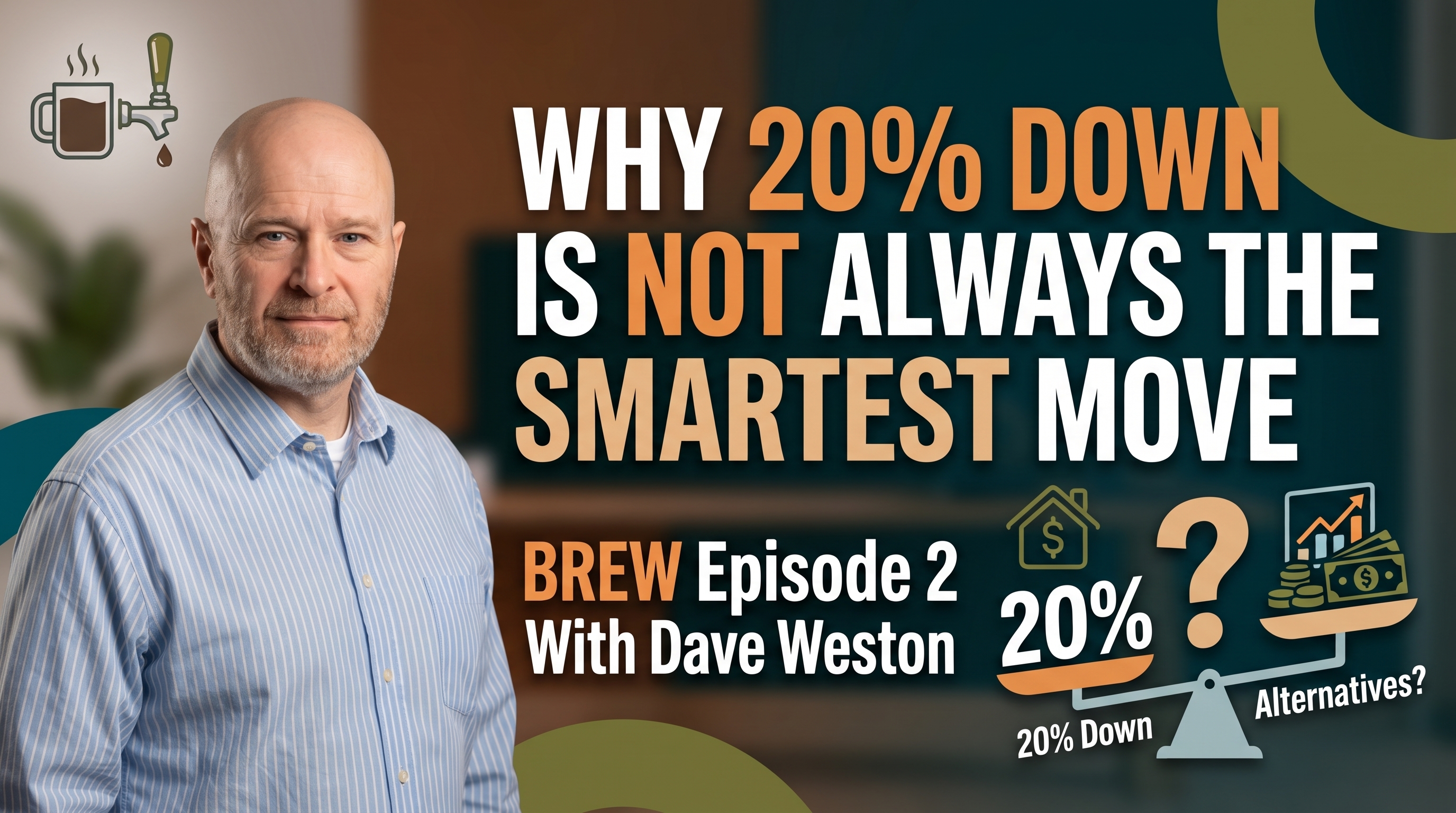
Putting 20 Percent Down Is Not Always the Smartest Financial Move and Here Is Why It Depends
The Question That Changes Everything About How You Think About a Down Payment
If you had eighty thousand dollars in the bank and you were getting ready to buy a house how much should you put down? Twenty percent? All of it? Dave Weston at the Dave Weston Group is asking a different question entirely and the answer might surprise you.
The real question is not how much can you put down. The better question is what does your money need to do for you after you buy the house?
Why Twenty Percent Is Not a Commandment
Twenty percent down became a familiar benchmark because conventional financing has traditionally treated that equity level differently particularly around private mortgage insurance. But somewhere along the way buyers started hearing you have to put twenty percent down as if it were a financial law rather than a guideline.
It is not a law. Sometimes it is absolutely the right decision. Sometimes it is not. And the goal of this conversation is to help you figure out which one applies to your specific situation rather than defaulting to a number that has more to do with convention than with your actual financial life.
The Concept That Changes the Conversation
Equity and cash are not the same thing and understanding the difference is the foundation of every down payment decision worth making.
If you have fifty thousand dollars sitting in a savings account you can use it tomorrow. If you have fifty thousand dollars of additional equity in your house and you suddenly need twenty thousand dollars you cannot walk up to the side of the house with a hammer and extract it. You have to access it through a home equity loan, a line of credit, or a refinance. And all of those depend on qualifications, available programs, property values, rates, costs, and market conditions that may or may not work in your favor when you need them most.
Equity creates wealth. Cash creates flexibility. A good financial plan may need both.
Buyer A and Buyer B: Where the Story Gets Interesting
Same income. Same debts. Same four hundred thousand dollar home. Both have one hundred thousand dollars available before closing costs and other expenses.
Buyer A puts eighty thousand dollars down following the twenty percent rule. The mortgage is three hundred and twenty thousand dollars. Potentially no mortgage insurance. More equity. Smaller loan.
Buyer B puts forty thousand dollars down at ten percent. Larger mortgage. Higher monthly payment. Possibly mortgage insurance. Stop the conversation there and Buyer A looks like the winner.
But Buyer B kept an additional forty thousand dollars. What happens to that money is where the story changes.
Buyer B creates three buckets. Fifteen thousand becomes emergency reserves. Ten thousand is set aside for moving costs, furniture, and near-term home expenses. Fifteen thousand stays available for long-term investing or other financial goals.
Now compare the two buyers. Buyer A has more equity and potentially a lower monthly payment. Buyer B has less equity and a higher monthly payment but significantly more liquidity. Which buyer is better off?
That depends entirely on the rest of their financial lives. And anyone who tells you the answer is automatically twenty percent down without understanding the full picture is answering the wrong question.
The Air Conditioner That Knows You Just Bought a House
Six months after closing the air conditioner dies. Apparently air conditioners have a way of knowing exactly when you have just made the largest purchase of your life and deciding that is the right moment to quit.
Eight thousand dollar expense. Buyer B has reserves. Annoying but not financially devastating. Buyer B writes the check and moves on.
Buyer A may have plenty of equity but if they used most of their available cash for the down payment the solution might now involve a credit card, consumer financing, or borrowing against the house. All of which cost money and create stress.
Being house rich and cash poor is still being cash poor. That is not an argument against equity. It is an argument for balance.
What to Do With the Mortgage Insurance Question
Some buyers spend enormous energy trying to avoid mortgage insurance rather than asking what strategy puts them in the strongest overall financial position. Those are not always the same question.
Spending an additional forty thousand dollars at closing to eliminate a monthly mortgage insurance expense is worth calculating carefully. What is the monthly difference? How long are you likely to carry that financing? What else could forty thousand dollars accomplish in that period? What reserves would you have left? Once you run the actual numbers the decision becomes clear rather than reflexive.
Mortgage insurance is not inherently good or bad. It is a cost. And like every cost it should be compared against what you receive in exchange for paying it.
Three Things to Remember: Reserve, Return, and Relief
Before deciding how much to put down ask what will I have left. Not how much do I have but what will I have left. Those are very different questions. If twenty percent down leaves seventy-five thousand dollars in reserve that is one conversation. If it leaves almost nothing that is a different conversation entirely.
Return asks what else could this money accomplish. Paying off higher interest debt. Funding a retirement account. Building emergency reserves. Supporting a business. Covering upcoming expenses. Every dollar has a job and before putting another ten or twenty or fifty thousand into your house the question worth asking is whether that is the best job for that dollar.
Relief is the factor that financial spreadsheets do not always capture. Some people genuinely hate debt and would lie awake at night with a fifty thousand dollar mortgage even if they had a million dollars in the bank. For that person more down may simply be worth it. Another person gets far more anxious when the bank account gets low and would rather have a slightly larger mortgage and six to twelve months of expenses sitting safely in reserve.
Neither person is wrong. Personal finance is personal. The mathematically perfect answer is not always the right answer if it creates a financial life you hate living.
What the Actual Loan Programs Offer
Conventional programs allow for substantially less than twenty percent down for qualifying borrowers. FHA financing allows smaller down payments for eligible buyers. VA and USDA programs can offer zero down financing for qualified borrowers and properties. Down payment assistance programs exist at the state and local level to help eligible buyers.
Each program has its own rules, costs, and trade-offs. The correct question is not what is the smallest down payment available or how do I get to twenty percent. The correct question is which structure best supports your overall financial plan.
The Framework Worth Using Before Choosing a Number
Take the cash you have available and build three scenarios side by side. Maybe five percent, ten percent, and twenty percent. Then compare them not just on payment but on how much cash remains after closing, what the monthly housing expense looks like, whether mortgage insurance is a factor, what high-interest debt could be eliminated instead, whether emergency reserves are adequate, and what financial goals the remaining money could support.
The biggest question in that comparison is which option leaves you in the strongest position the day after closing. Not on closing day. After closing. Because closing is not the finish line. It is day one.
What the Dave Weston Group Is Actually Trying to Accomplish
When you buy a home through the Dave Weston Group the conversation is not simply about getting through underwriting and handing over the keys. It is about how this decision helps you build wealth, how to structure things so you can protect what you are building when life throws something unexpected at you, and how your home becomes part of the wealth you eventually transfer to the people and causes that matter most to you.
Your mortgage is not the financial plan. It is one piece of the financial plan. Your down payment is not simply an amount of money. It is a decision about where you want your money working.
Sometimes twenty percent down is absolutely the right answer. Sometimes ten percent is. Sometimes five percent is. For eligible borrowers sometimes zero makes sense. The important part is not finding a magic percentage. It is knowing why you chose yours.
Reach out to Dave Weston at the Dave Weston Group at 573-587-3380 to build the plan that makes the right down payment decision clear for your specific situation.
Sources
ConsumerFinancialProtectionBureau.gov
FannieMae.com
MortgageNewsDaily.com
NationalFoundationForCreditCounseling.org
Investopedia.com

Mortgage Calculator
See your total mortgage payments using the tool below.
| Year | Interest | Principal | Balance |
|---|