
Your Local Mortgage Lender
Located in Girardeau, Missouri
Personalized Mortgage Experience
Buying a home should feel exciting… not overwhelming.
At The Dave Weston Group, we guide you through every step so you feel confident, informed, and completely at home in the process.
But this is about more than just getting a loan…
It’s about helping you build, protect, and transfer wealth through real estate.
From your first home to your next investment, we’re here to help you make smart decisions that serve you now… and long-term.
Simple. Clear. Done right.
The Home Loan Process
Mortgage Pre-Approval
Get pre-approved from one of our Loan Officers to see how much you can afford.
House Shopping
Work with a trusted Real Estate Agent to find a home you would like to move into.
Loan Application
Complete your home loan application to get the lending process started.
Don't take my word for it
Mortgage Programs
Experience the best mortgage experience located in Girardeau, Missouri.
Home Loan Options
Our experienced mortgage advisors will walk you through the best mortgage loan program that will fit your specific scenario.
Conventional Home Loans.
FHA Home Loans.
USDA Home Loans.
VA Home Loans.
Frequently Asked Questions
How often can I refinance my mortgage?
There is no limit to the number of times you can refinance. However, you must qualify every time you apply and there will be costs associated with closing the loan each time.
Can I buy a home if I do not have money for a down payment?
Yes! There are a number of bond programs that offer low or no down payment financing options.
How do I know which mortgage is right for me?
The key to choosing the right mortgage is to understand the range of options and features available to you, as well as your budget, circumstances, and goals. Our licensed mortgage professionals are here to help you navigate that process. The more you know, the more comfortable and confident you will be choosing the best option for you and your family.
How long will the loan process take?
The Truth in Lending Act (TILA) does not permit a lender to close a loan until at least seven (7) business days have passed from the date your application was received. A typical home loan takes 30 days, as a number of third-party services such as appraisals, title work, and credit are required in conjunction with the mortgage process. Once you familiarize your Loan Officer with the details of your specific loan scenario, they will be able to provide you with a more specific timeline.
Will I qualify for a home loan?
The only way to find out is to speak with a qualified mortgage professional. Our Loan Officers have helped numerous clients who didn’t know if they could qualify to become home owners. We take the time to understand your financial situation and long-term financial goals, and then match you with the loan program that best fits your needs. Your approval for a loan may also largely depend on the price of the home you are financing. Getting pre-qualified prior to beginning your home search can give you an idea of what you may be able to afford.
Why do people refinance their mortgages?
Homeowners typically refinance to save money, either by obtaining a lower interest rate or by reducing the term of their loan. Refinancing is also a way to convert an adjustable loan to a fixed loan or to consolidate debts.
How much money will I have to pay upfront to buy a home?
This question does not have a simple, one-size-fits-all answer. The exact amount will depend on the price of the home you buy as well the type of mortgage financing you choose. Depending on your loan program, your down payment could be as much as 20% of the home’s price or as little as 3%, while some loans require no down payment at all.
Can I get a mortgage after bankruptcy?
You may still qualify for a home loan even if you have experienced a bankruptcy. The best way to find out if you qualify is to talk with a Loan Officer to discuss your options. Be sure to bring all paperwork regarding your bankruptcy so your Loan Officer can find the program that best fits your situation.
Should I lock my interest rate now, or wait until we are closer to our closing?
Interest rates fluctuate all day, every day. If an interest rate is good, it may be in your best interest to lock now. If you wait, you run the risk of an increase in rates later. If you are concerned that rates may go down after you lock, contact your Loan Officer to discuss your options. Some programs allow you to lock for an extended period and choose to lower your rate should a better one become available.
Most Recent Blog Updates
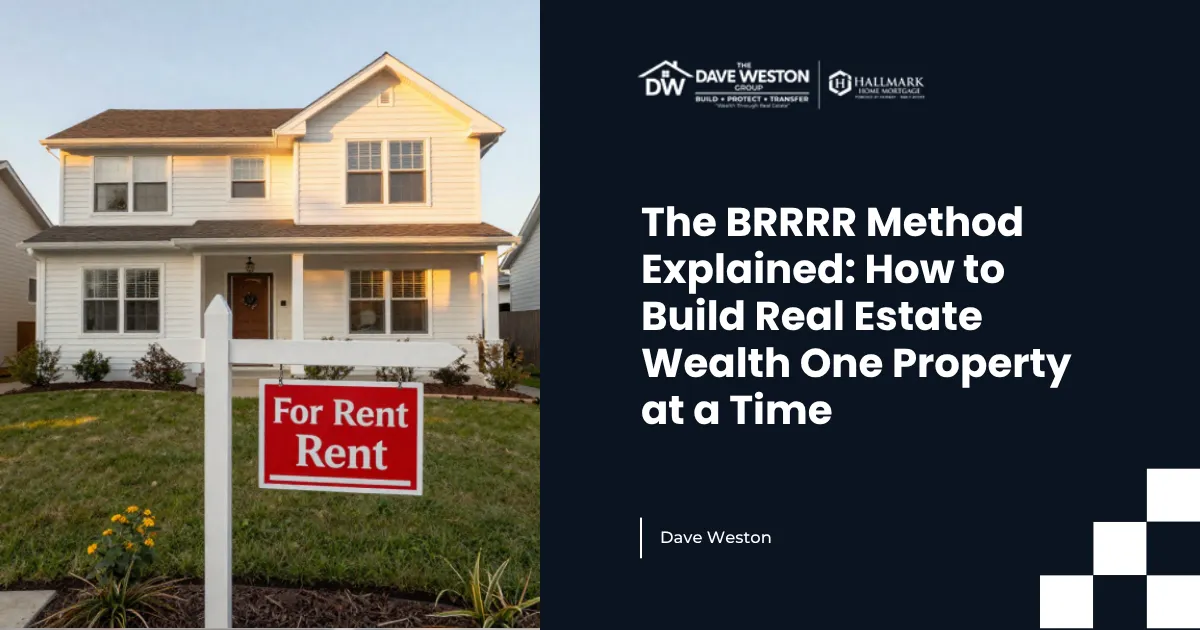
The BRRRR Method Explained: How to Build Real Estate Wealth One Property at a Time
Most people believe you need a fortune to start investing in real estate. That belief is exactly why so many never take the first step. But there's a proven strategy that allows investors to buy a property, improve it, rent it out, pull their original money back, and do it all over again. It's called the BRRRR method, and it's one of the most powerful systems for building long-term wealth through real estate.
According to Dave Weston, a mortgage professional with more than two decades of experience helping families purchase and refinance homes, the people who build real wealth through real estate don't just buy one property. They build a repeatable system. The BRRRR method is that system.
What Does BRRRR Stand For?
BRRRR is an acronym for Buy, Rehab, Rent, Refinance, and Repeat. Each step plays a specific role in turning a single property into a long-term wealth-building machine. When executed correctly, the method allows investors to recycle the same pool of capital across multiple deals over time.
Step One: Buy the Right Property
This is where you make your money. As Dave Weston often points out, you don't make your money when you sell a property, you make it when you buy. The goal is to find undervalued properties, which doesn't necessarily mean cheap. It means priced below what the home could be worth after improvements.
For example, you might buy a property for $120,000 that, once fully renovated, is worth $200,000. That spread is where your opportunity lives. To find these deals, work with an investor-friendly agent, use MLS filters like "as-is," "investor special," or "needs TLC," and consider driving neighborhoods to spot overlooked homes. Property managers can also be a goldmine for leads on tired rentals that owners are ready to offload.
Step Two: Rehab With Purpose
Once you own the property, it's time to rehab it. The key is to fix it for functionality and rental appeal, not for an HGTV makeover. Many new investors over-improve and spend $40,000 when $20,000 would have done the job.
Focus on ROI-driven repairs: fresh paint, durable flooring, a clean kitchen refresh, updated bathrooms, and modern light fixtures. These low-cost, high-impact upgrades attract quality tenants without eating into your future cash flow.
Step Three: Rent It Out
This is where the wealth-building begins. A solid tenant gives you consistent cash flow, pays down your mortgage balance, and provides long-term stability.
Say your rent is $1,400 per month and your mortgage payment is $1,000. That $400 spread is your monthly income, while your tenant is essentially building equity for you in the background.
Step Four: Refinance and Recycle Your Capital
This is the step that separates BRRRR from traditional buy-and-hold investing. Once the property is rented and stabilized, you refinance based on its new, improved value. Using the earlier example, you bought the home for $120,000, invested $20,000 in repairs, and now it appraises for $200,000. A cash-out refinance may allow you to pull most or all of your original investment back out.
That recycled capital becomes the down payment on your next property. As Dave Weston explains, refinancing also often results in better loan terms and a wider gap between your rent received and your mortgage payment.
Step Five: Repeat the Process
This is where wealth compounds. You take the same system and apply it again. Over time, rents increase, loan balances decrease, and property values appreciate. Stacking properties using a repeatable process is how real estate quietly creates generational wealth.
Why Structure Matters From Day One
The BRRRR method only works when it's structured correctly upfront. Loan type, exit strategy, appraisal expectations, and cash-out guidelines all matter. Deals often fall apart not because the property was bad, but because the financing wasn't set up properly from the beginning. That's why having an experienced lending partner and a strong team is essential before you ever make an offer.
Final Thoughts
Real estate wealth isn't built in one deal. It's built in the repeat. The BRRRR method, when executed with the right team and the right plan, can turn a single property into a foundation for lasting financial freedom.
Sources

Mortgage Calculator
See your total mortgage payments using the tool below.
| Year | Interest | Principal | Balance |
|---|